Browsed by
Category: 2025-2026 Mayor Dr Matt Lamb

MAYOR’S WEEK: 15 – 21 FEBRUARY 2026

MAYOR’S WEEK: 15 – 21 FEBRUARY 2026

Four people standing in front of a University of Worcester sign
Dr Rachael Paige, Interim Head of the Institute of Education at the University of Worcester; Professor David Green, University of Worcester Vice Chancellor and Chief Executive; the Mayor; and the Mayoress

It has been another wonderfully varied week serving Worcester, highlighting the talent, generosity and community spirit that define our city.

I was delighted to tour the University of Worcester, joined by my Mayoress, Cllr Zoe Cookson. We were shown around by Dr Rachael Paige, Interim Head of the Institute of Education, and Professor David Green, Vice Chancellor and Chief Executive. It was a pleasure to see the facilities across the various campuses and to witness first-hand the continued investment in teaching spaces, specialist laboratories and student support services. The energy and ambition across the university are impressive. I was also pleased to record a short reflection for the university’s Early Career Teacher Podcast, speaking about my own career in education and the transformative power of learning. Worcester is fortunate to have such a dynamic institution at its heart.

Community action was equally evident at the fantastic Repair Café, held at the university. This initiative invites residents to bring broken items – from bikes to lawnmowers, vacuum cleaners to clocks, televisions to clothing – and work alongside skilled volunteers to restore them. These enthusiastic volunteers generously give up their Saturday mornings to share their expertise, helping people save money while reducing waste and supporting our environment. I even benefited personally when a loose button on my coat was expertly sewn back on. With homemade cake, tea and coffee on offer, the atmosphere is warm, friendly and welcoming – sustainability in action, rooted in community spirit.

On a more intergalactic note, I was thrilled to attend Worcester Comic Con in the university area. As a lifelong fan of science fiction and comics, it was a joy to see so many families embracing creativity and imagination. I had the honour of helping judge the “Tiny Tots” costume competition – no easy task given the high standard on display. I even came face to face with the Daleks from Doctor Who – thankfully, they behaved themselves.

Finally, I was proud to formally open the newly refurbished gym and fitness suite at Perdiswell Leisure Centre. Operated by Freedom Leisure on behalf of Worcester City Council, the upgraded facilities provide a modern, welcoming space for residents of all ages and abilities. Investment in leisure is an investment in public health and wellbeing, helping residents stay active, connected and healthy throughout their lives.

I look forward to hosting my Masquerade Charity Banquet on Friday 20 March at the historic Worcester Guildhall in support of Acorns Children’s Hospice. It promises to be a wonderful evening of community, celebration and fundraising for a truly vital cause. Tickets are available here.

MAYOR’S WEEK: 8 -14 FEBRUARY 2026

MAYOR’S WEEK: 8 -14 FEBRUARY 2026

This week has been a joyful reminder of the richness of Worcester’s cultural life, the strength of our community, and the importance of civic engagement at every level – local and national.

On Saturday morning, the Mayoress, Zoe Cookson, and I were delighted to take part in the parade launching the Great Recitations Festival, celebrating Worcester’s literary heritage and our special connection with Charles Dickens.

We gathered in the Cornmarket, near the site of the former Public Hall, where Dickens once read A Christmas Carol to a Worcester audience. It was a powerful thought – imagining his voice bringing those immortal characters to life in our city.

It felt especially fitting that the festival began on February 7, Dickens’ birthday. Literature is not confined to the page; it is something to be shared, recited and enjoyed together.

Leading the parade to Script Haven was symbolic – carrying stories from the past into the present and into the heart of Worcester’s creative life.

We were honoured to welcome Lucinda Dickens Hawksley, the author’s three-times great-granddaughter, alongside Professor Christine Skelton. My particular thanks go to Leena at Script Haven, whose vision and determination made this wonderful festival possible.

We also attended the official opening of Indya, the new restaurant on Friar Street – a fantastic addition to Worcester’s growing dining sector. It is always encouraging to see new independent businesses choosing to invest in our city centre.

The evening was held in support of Sensory Matters, and we had the pleasure of spending time with Collette Bedford, who shared more about the charity’s inspiring work.

Sensory Matters supports children and young people with sensory processing differences and additional needs, offering practical support, specialist resources and a welcoming community for families navigating often complex challenges. It was heartening to see a local business launch aligned with such a meaningful cause.

The Mayoress and I were also honoured to visit the House of Lords as guests of Lord Faulkner of Worcester. We enjoyed lunch in the historic dining room, observed Question Time, and – of particular interest to us as councillors – watched the committee stage of the English Devolution Bill.

The legislation will have significant implications for the future shape of local government and decision-making in cities like Worcester. It was fascinating to see the legislative process up close and to reflect on how national decisions will impact our local communities.

From celebrating Dickens in the Cornmarket, to supporting a new restaurant on Friar Street, to observing debate in the House of Lords, this week has reflected the breadth of the mayoral role – championing culture, supporting enterprise and good causes and engaging with the future governance of our city.

MAYOR’S WEEK: 1 – 7 FEBRUARY 2026

MAYOR’S WEEK: 1 – 7 FEBRUARY 2026

The Mayor and a group of people inside The Hive building in Worcester
The Mayor and other dignitaries and guests at the opening of the Between Life and Death: Holocaust Rescue Stories in The Hive

This week I had the privilege of attending, and helping to open, the powerful exhibition Between Life and Death: Holocaust Rescue Stories, now on display at The Hive in Worcester.

The exhibition opened just a week after Holocaust Memorial Day, a time when we pause to remember the six million Jewish men, women and children murdered in the Holocaust, alongside the millions of others persecuted by the Nazi regime. That timing is significant. Remembrance cannot be confined to a single day; it must be something we continue, deepen and renew through learning, reflection and dialogue.

The opening event itself reflected that shared commitment. Speeches were given by several attendees, including the organisers of the exhibition, Worcestershire Interfaith Forum, Louis Stephen, Chair of Worcestershire County Council, and myself as Mayor of Worcester. We were also honoured to be joined by Professor David Green, Vice Chancellor and Chief Executive of the University of Worcester, whose address underlined the vital role of education and research in challenging distortion, denial and hatred.

It was particularly special to welcome Beata Drzazga, one of the exhibition’s organisers, who flew from Warsaw to attend the opening in person. This exhibition exists in only two versions worldwide: the other is currently displayed at the United Nations in New York. Worcester is only the second location in the UK to host it, which is both a privilege and a responsibility.

Another deeply moving contribution came from Samantha Lewkowicz, Holocaust Education Officer at the Union of Jewish Students. She spoke powerfully about the challenges still facing those working to preserve the memory of the Holocaust, especially as the number of survivors and direct witnesses continues to decline. Her words were a stark reminder that remembrance cannot be taken for granted.

In my own remarks, I reflected on my personal connection to this history. I studied History at the University of Worcester, and the Holocaust has been an enduring interest of mine since childhood. One of the books that left a lasting impression on me was The Rise and Fall of the Third Reich by William L. Shirer, which opens with George Santayana’s warning: “Those who cannot remember the past are condemned to repeat it.” That sentence has stayed with me ever since.

What makes Between Life and Death especially compelling is its focus on rescue. Spanning 14 European countries, it tells the stories of individuals who, in the darkest of times, chose humanity over fear. These were often ordinary people faced with extraordinary moral choices, whose actions meant the difference between life and death.

The exhibition is free to visit at The Hive until 28 February, and I would strongly encourage residents and visitors alike to engage with it thoughtfully. By remembering stories of rescue, we honour those who survived, those who helped them, and the enduring importance of never forgetting.

MAYOR’S WEEK: 25 – 31 JANUARY 2026

MAYOR’S WEEK: 25 – 31 JANUARY 2026

The Mayor and three other people standing in Worcester Guildhall
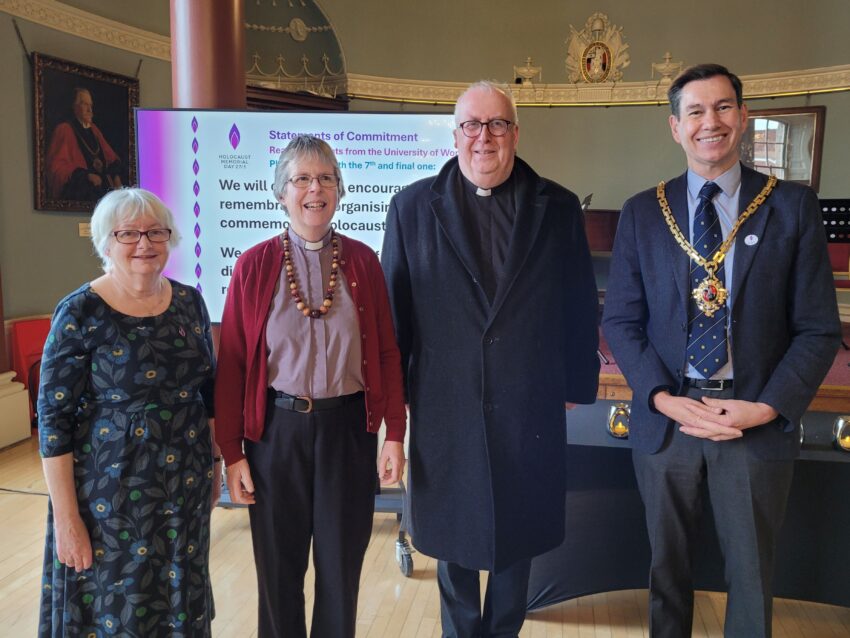
Yvonne Stollard and Rev Catherine Lack of The Interfaith Forum, guest speaker Rev Tony Rindl and the Mayor at the Holocaust Memorial Day event in Worcester Guildhall

Holocaust Memorial Day is always a moment of deep reflection, and it was an honour to welcome residents, pupils and guests to the Guildhall for Worcester’s 2026 Holocaust Memorial Day commemoration.

We gathered to remember the six million Jewish men, women and children who were murdered in the Holocaust. We also remembered the millions of others persecuted and killed by the Nazi regime, including Roma and Sinti people, disabled people, gay men, political opponents and others whose lives were destroyed by hatred and exclusion.

This year’s theme, “Bridging Generations,” felt particularly resonant. As time passes, fewer Holocaust survivors are able to share their experiences in person. Their voices have shaped our understanding in ways no textbook ever could. As those voices grow quieter, the responsibility of remembrance does not diminish – it grows. Memory must be carried forward by future generations, and by all of us.

Bridging generations means ensuring that these histories do not become distant or abstract. The Holocaust was not a single event, but the systematic destruction of lives, families and entire communities. Whole generations were wiped out, and many left no descendants to tell their stories. Their legacy now rests in testimony, education, and in our collective commitment to remember.

The event powerfully reflected this theme. Pupils from local schools took part alongside our guest speaker, the Reverend Tony Rindl, whose father escaped Nazi Germany and came to the UK on the Kindertransport. I found Reverend Rindl’s account of his father’s experience both deeply moving and profoundly inspiring. It was a reminder of the fragility of freedom, but also of the compassion shown by those who offered refuge in humanity’s darkest moments.

It was especially important to see so many local schools and the University of Worcester involved in the commemoration. Pupils and students from the Royal Grammar School, Nunnery Wood High School, King’s School, Bishop Perowne CE College, Tudor Grange Academy, Christopher Whitehead Language College and New College Worcester all took part. Their presence showed how remembrance is being actively carried forward by younger generations.

I was grateful for the involvement of the Worcestershire Interfaith Forum, and I would particularly like to thank the Reverend Catherine Lack for her contribution and support. Events like this demonstrate the power of faith communities, schools and civic institutions working together.

The Holocaust did not begin with murder; it began with prejudice, lies and the gradual erosion of empathy. Remembering this challenges us to stand firmly against antisemitism, racism and intolerance in all its forms.

By coming together, Worcester honoured those who were murdered, bore witness to history, and reaffirmed a shared commitment to compassion, justice and human dignity.